Binning Temporal Hypergraphs
Tutorial
Code to perform hypergraph binning method derived in “Inference of dynamic hypergraph representations in temporal interaction data” (Kirkley, 2024, https://arxiv.org/abs/2308.16546).
Inputs a list containing events between two disjoint node sets, with entries of the form (source node, destination node, weight, time), where:
source node: Node from first set (i.e. a user).
destination: Node from second set (i.e. an item purchased by the user).
weight: The weight of the event, representing its significance or frequency (i.e. the cost of the item).
time: The time at which the event occurs.
Also inputs a desired resolution dt for time discretzation, and whether to use exact dynamic programming or an approximate greedy method for the inference.
Outputs compression ratio, event clusters, and number of time steps, where:
compression ratio: The ratio of the description length after event binning to the description length of naive transmission.
event clusters: A list assigning each event to a temporal cluster label where the events can be aggregated into a weighted hypergraph or bipartite graph.
number of time steps: The number of time steps corresponding to the specified width (dt).
The method minimizes the following nonparametric Minimum Description Length (MDL) clustering objective over 1D segmentations  of the time interval:
![\[
\mathcal{L}_{\text{total}}(\mathcal{X}, \tau) = \sum_{k=1}^{K} \mathcal{L}_{\text{cluster}}^{(k)},
\]](../_images/math/02d543c313045c841ab0fb17fdf71758816f6bab.png)
where
![\[
\mathcal{L}_{\text{cluster}}^{(k)} = \log(N - 1)(T - 1) + \log\left(\binom{S}{m_k}\right)\left(\binom{D}{m_k}\right)\left (\binom{\tau_k}{m_k}\right) + \left[\log \Omega(s^{(k)}, d^{(k)}) + \log \Omega(G^{(k)}, n^{(k)}) \right]
\]](../_images/math/8e4581fe49bf33a0be203ced3e214523fcfde2ea.png)
is the description length of the k-th temporal cluster according to Eq. 14 in https://arxiv.org/pdf/2308.16546.
MDL Hypergraph Binning
This module provides functions to calculate the logarithm of binomial and multinomial coefficients, as well as to identify the Minimum Description Length (MDL) configuration for hypergraph binning.
Functions
All of the following functions are provided in this module and have the same general usage as described below.
Function |
Description |
|---|---|
Compute the logarithm of the binomial coefficient. |
|
Compute the logarithm of the multinomial coefficient over count data. |
|
Compute the logarithm of the number of non-negative integer matrices with specified row and column sums. |
|
Identify the MDL-optimal temporally contiguous partition of event data. |
|
Compute the cluster-level description length. |
Reference
Description: Compute the logarithm of the binomial coefficient.
Parameters:
- n: Total number of items.
- k: Number of chosen items.
- Returns:
float: Logarithm of the binomial coefficient.
Description: Compute the logarithm of the multinomial coefficient over count data.
Parameters:
- counts: Count data for which the multinomial coefficient is calculated.
- Returns:
float: Logarithm of the multinomial coefficient.
Description: Compute the logarithm of the number of non-negative integer matrices with specified row and column sums.
Parameters:
- rs: Array of row sums.
- cs: Array of column sums.
- swap: Boolean to swap the definition of rows and columns for a minor accuracy improvement.
- Returns:
float: Logarithm of the number of non-negative integer matrices.
Description: Identify the MDL-optimal temporally contiguous partition of event data X at resolution dt.
Parameters:
- X: List of event data entries, each in the form [source, destination, weight, time].
- dt: Time discretization width.
- exact: Boolean to indicate whether to use the exact dynamic programming solution or the faster approximate greedy solution.
- Returns:
best_MDL/L0: Compression ratio eta for MDL-optimal temporally contiguous partition of event data X.
labels: Partition of the event data into event clusters.
T: Number of time steps corresponding to width dt.
Description: Compute the description length for cluster corresponding to the time interval [i,j].
Parameters:
- i: Interval start index.
- j: Interval end index.
- Returns:
float: Cluster-level description length.
Demo
The following example demonstrates how to use the MDL_hypergraph_binning function on an event dataset X with a time step width dt.
Example Code
Step 1: Import necessary libraries
import time
from paninipy.hypergraph_binning import MDL_hypergraph_binning
import matplotlib.pyplot as plt
Step 2: Generate synthetic event dataset and choose time discretization
X = [('A','1',1,0.1),('B','1',1,0.2),('B','1',1,0.3),('A','1',1,0.4),('B','1',1,0.5),
     ('B','1',1,1),('C','2',1,2),('A','2',1,3),('B','2',1,4),('C','2',1,5)]
dt = 0.1
Step 3: Run the exact dynamic programming algorithm
start_exact = time.time()
results_exact = MDL_hypergraph_binning(X, dt, exact=True)
runtime_exact = time.time() - start_exact
Step 4: Run the fast greedy agglomerative algorithm
start_greedy = time.time()
results_greedy = MDL_hypergraph_binning(X, dt, exact=False)
runtime_greedy = time.time() - start_greedy
Step 5: Display results
print('Exact Dynamic Program Results: ')
print('     compression ratio =', round(results_exact[0], 4))
print('     MDL-optimal event partition =', results_exact[1])
print('     number of time steps =', results_exact[2])
print('     runtime =', round(runtime_exact, 4))

print('Greedy Algorithm Results: ')
print('     compression ratio =', round(results_greedy[0], 4))
print('     MDL-optimal event partition =', results_greedy[1])
print('     number of time steps =', results_greedy[2])
print('     runtime =', round(runtime_greedy, 4))
Step 6: Function to visualize the binning results
def visualize_binning(X, result, method):
    labels = result[1]
    times = [t for _, _, _, t in X]
    pairs = [(src, dest) for src, dest, _, _ in X]
    times_transformed = times
    unique_nodes = sorted(list(set([src for src, dest in pairs] + [dest for src, dest in pairs])))
    node_pos = {node: i for i, node in enumerate(unique_nodes)}

    colors = ['skyblue' if label == 0 else 'lightcoral' for label in labels]

    fig, ax = plt.subplots(figsize=(12, 4))
    for (src, dest), time, color in zip(pairs, times_transformed, colors):
        src_pos = node_pos[src]
        dest_pos = node_pos[dest]
        ax.plot([time, time], [src_pos, dest_pos], color=color, marker='o', markersize=11, linestyle='-', zorder=1)
        ax.text(time, src_pos, f"{src}", ha='center', va='center', fontsize=9, fontweight='bold', zorder=2, color='black')
        ax.text(time, dest_pos, f"{dest}", ha='center', va='center', fontsize=9, fontweight='bold', zorder=2, color='black')

    ax.set_xlim(min(times_transformed) - 0.5, max(times_transformed) + 0.5)
    ax.set_ylim(min(node_pos.values()) - 1, max(node_pos.values()) + 1)
    ax.set_yticks([])
    ax.set_xlabel('Time')
    ax.set_title(f'Event Partition in Time Scale with {method} Dynamic Solution')
    plt.savefig(f"timeline_plot_with_log_transform_{method}.png", bbox_inches='tight', dpi=200)
    plt.show()
Step 7: Visualize the binning results for the exact dynamic programming
visualize_binning(X, results_exact, 'exact dynamic programming')
Step 8: Visualize the binning results for the fast greedy agglomerative
visualize_binning(X, results_greedy, 'fast greedy agglomerative')
Example Output
Exact Dynamic Program Results:
    compression ratio = 0.9842
    MDL-optimal event partition = [0 0 0 0 0 0 1 1 1 1]
    number of time steps = 50
    runtime = 0.006
Greedy Algorithm Results:
    compression ratio = 0.9913
    MDL-optimal event partition = [0 0 0 0 0 1 1 1 1 1]
    number of time steps = 50
    runtime = 0.0036
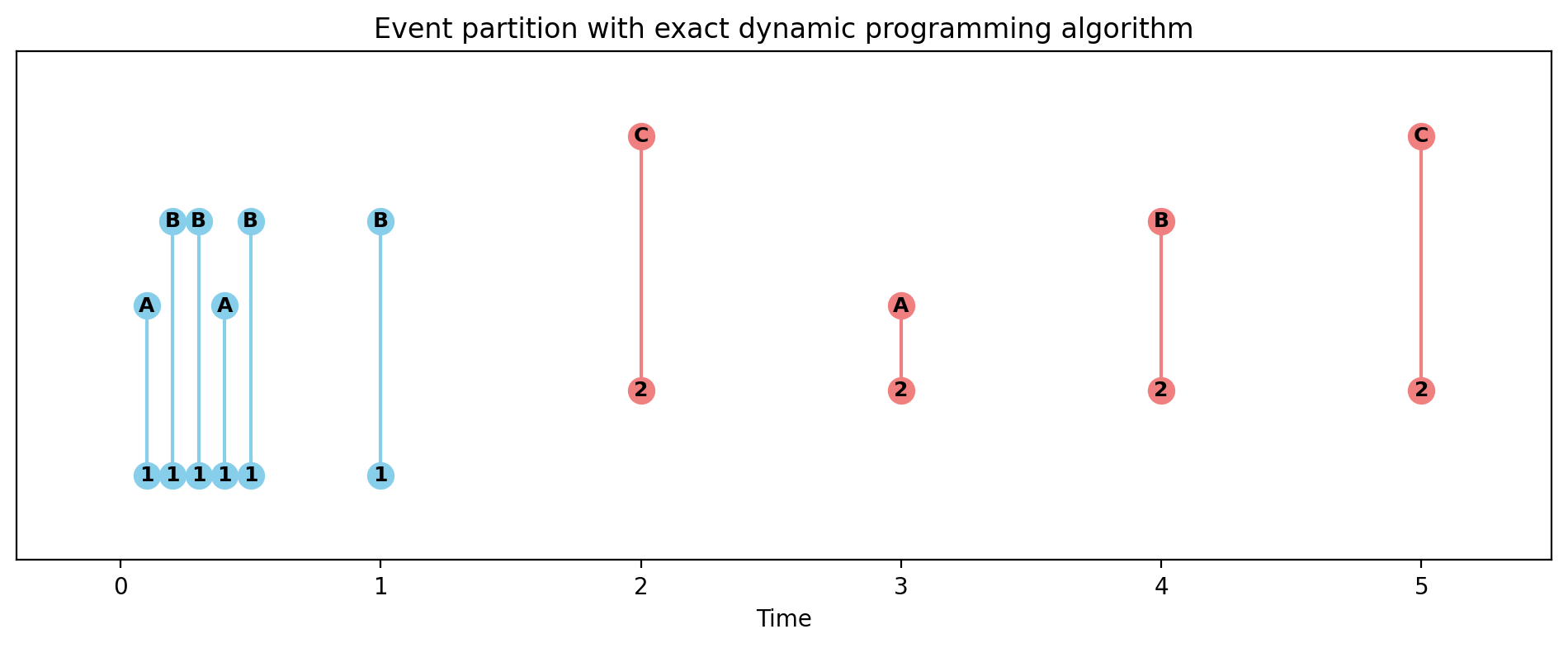
Hypergraph binning results for synthetic dataset with exact dynamic programming solution. The x-axis represents time and the events are plotted with colors indicating event clusters. Events labeled with “0” are partitioned into the first group (light blue), and events labeled with “1” are partitioned into the second group (light red). Each group forms a cohesive hypergraph structure involving the two sets of nodes.
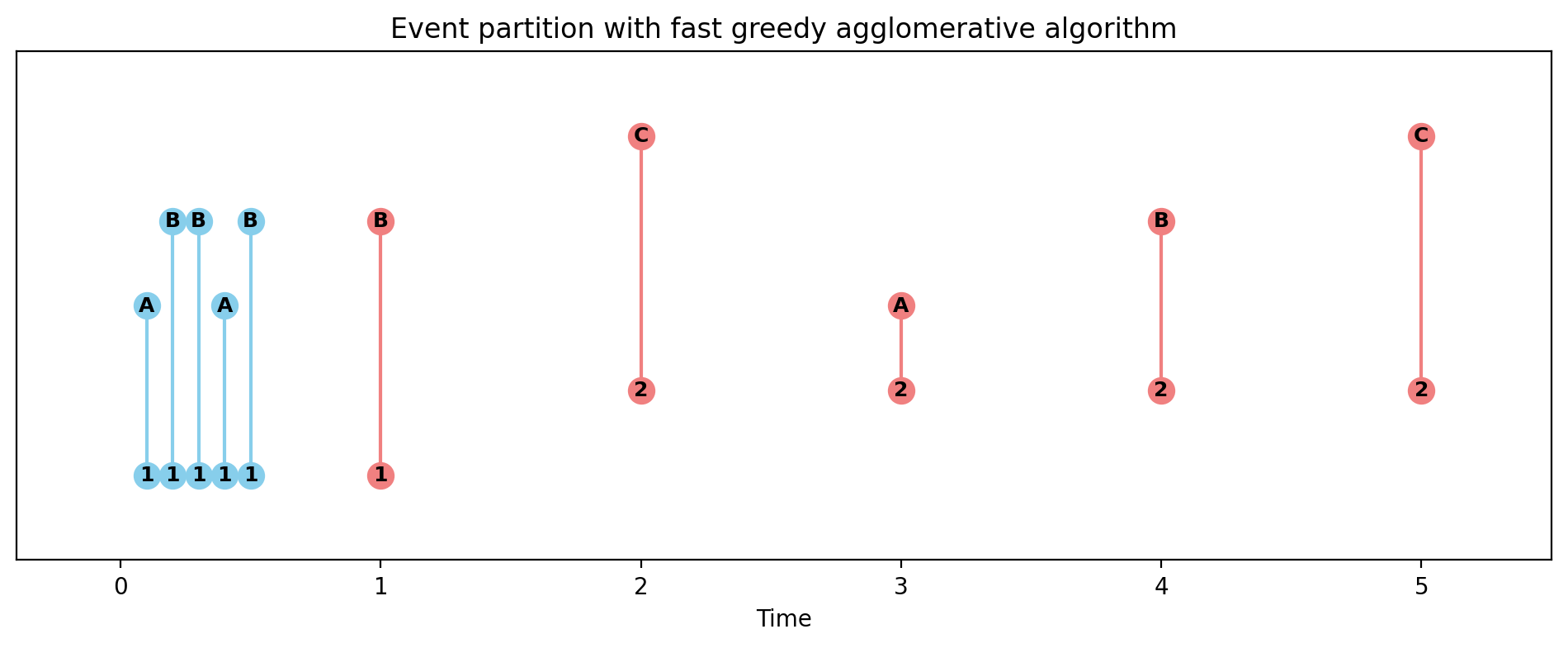
Hypergraph binning results for synthetic dataset with greedy agglomerative solution.
Paper source
If you use this algorithm in your work, please cite:
A. Kirkley, Inference of dynamic hypergraph representations in temporal interaction data. Physical Review E 109, 054306 (2024). Paper: https://arxiv.org/abs/2308.16546