MDL Network Backbones
Tutorial
Code to perform network backboning method derived in “Fast nonparametric inference of network backbones for weighted graph sparsification” (Kirkley, 2024, https://arxiv.org/abs/2409.06417).
The function allows for both directed and undirected networks and provides options to adjust the analysis according to the network’s characteristics.
elist: A list consisting of directed tuples
 representing edges from node
  to node
  with weight
  .
.directed: Specify whether the input edge list is directed or undirected.
out_edges: Determine whether to track out-edges or in-edges attached to each node in the local pruning method.
allow_empty: Decide whether to allow empty backbones when the minimum description length is achieved with no edges.
Outputs include the global and local network backbones along with their inverse compression ratios:
backbone_global: Edge list of the global MDL-optimal backbone.
backbone_local: Edge list of the local MDL-optimal backbone.
compression_global: Inverse compression ratio for the global backbone.
compression_local: Inverse compression ratio for the local backbone.
The method minimizes the following MDL objectives according to Eq. 1 and Eq. 5 in https://arxiv.org/abs/2409.06417:
Microcanonical Global Description Length Objective of Network Backbone:

Microcanonical Local Description Length Objective of Network Backbone:

MDL Backboning
This module provides functions to calculate the MDL-optimal network backbones for both global and local perspectives.
Function |
Description |
|---|---|
Compute the logarithm of the binomial coefficient. |
|
Compute the logarithm of the multiset coefficient. |
|
Convert a directed edge list to an undirected edge list by merging edges. |
|
MDL_backboning(elist, directed=True, out_edges=True, allow_empty=True) |
Compute the MDL-optimal global and local network backbones. |
Reference
Description: Compute the logarithm of the binomial coefficient.
Parameters:
- n: Total number of items.
- k: Number of chosen items.
- Returns:
float: Logarithm of the binomial coefficient.
Description: Compute the logarithm of the multiset coefficient.
Parameters:
- n: Number of types.
- k: Number of items.
- Returns:
float: Logarithm of the multiset coefficient.
Description: Convert a directed edge list to an undirected edge list by merging edges.
Parameters:
- edge_list: List of directed edges as tuples (i, j, w_ij).
- policy: Policy for merging edges, can be "sum", "max", "min", or "error". Defaults to "sum".
- Returns:
list: Undirected edge list as tuples (i, j, w_ij) where edges are merged according to the specified policy.
Description: Compute the MDL-optimal global and local network backbones from the given edge list.
Parameters:
- elist: List of edges as tuples (i, j, w_ij).
- directed: Boolean indicating if the network is directed, defaults as `True`.
- out_edges: Boolean indicating whether to track out-edges (`True`) or in-edges (`False`), defaults as `True`.
- allow_empty: Allows empty backbones if `True`, defaults as `True`.
- Returns:
backbone_global: Edge list of the global MDL-optimal backbone.
backbone_local: Edge list of the local MDL-optimal backbone.
compression_global: Inverse compression ratio for the global backbone.
compression_local: Inverse compression ratio for the local backbone.
Demo
Example Code
Step 1: Import necessary libraries
import networkx as nx
import matplotlib.pyplot as plt
from paninipy.mdl_backboning import MDL_backboning
Step 2: Define the weighted edge list
# Weighted edge list for the example
elist = [
    (0, 1, 12), (0, 3, 20), (0, 4, 8),
    (1, 2, 1), (1, 4, 3),
    (2, 0, 1), (2, 1, 3),
    (3, 2, 3), (3, 4, 1),
    (4, 3, 1)
]
Step 3: Compute backbones and compression ratios
# Compute backbones using out-edges
backbone_global, backbone_local, compression_global, compression_local = MDL_backboning(
    elist, directed=True, out_edges=True
)
Step 4: Visualize the original network and backbones
def visualize_backbones(elist, backbone_global, backbone_local, compression_global, compression_local):
    G_original = nx.DiGraph()
    G_global = nx.DiGraph()
    G_local = nx.DiGraph()

    for i, j, w in elist:
        G_original.add_edge(i, j, weight=w)
    for i, j, w in backbone_global:
        G_global.add_edge(i, j, weight=w)
    for i, j, w in backbone_local:
        G_local.add_edge(i, j, weight=w)

    pos = nx.spring_layout(G_original, seed=42)
    W_original = sum([d['weight'] for u, v, d in G_original.edges(data=True)])
    E_original = G_original.number_of_edges()

    W_global = sum([d['weight'] for u, v, d in G_global.edges(data=True)])
    E_global = G_global.number_of_edges()

    W_local = sum([d['weight'] for u, v, d in G_local.edges(data=True)])
    E_local = G_local.number_of_edges()

    plt.figure(figsize=(18, 6))

    plt.subplot(1, 3, 1)
    nx.draw_networkx_nodes(G_original, pos, node_color='lightblue', node_size=500)
    nx.draw_networkx_edges(G_original, pos, arrowstyle='->', arrowsize=15)
    nx.draw_networkx_labels(G_original, pos)
    plt.title('Original Network')
    plt.axis('off')
    plt.text(0.5, -0.1, f'Total weight of the network = {W_original}\nTotal number of edges = {E_original}', ha='center', transform=plt.gca().transAxes)

    plt.subplot(1, 3, 2)
    nx.draw_networkx_nodes(G_global, pos, node_color='red', node_size=500)
    nx.draw_networkx_edges(G_global, pos, arrowstyle='->', arrowsize=15)
    nx.draw_networkx_labels(G_global, pos)
    plt.title('Global Backbone')
    plt.axis('off')
    plt.text(0.5, -0.1, f'Total weight of the network = {W_global}\nTotal number of edges = {E_global}\nInverse compression ratio = {compression_global:.4f}', ha='center', transform=plt.gca().transAxes)

    plt.subplot(1, 3, 3)
    nx.draw_networkx_nodes(G_local, pos, node_color='lightgreen', node_size=500)
    nx.draw_networkx_edges(G_local, pos, arrowstyle='->', arrowsize=15)
    nx.draw_networkx_labels(G_local, pos)
    plt.title('Local Backbone')
    plt.axis('off')
    plt.text(0.5, -0.1, f'Total weight of the network = {W_local}\nTotal number of edges = {E_local}\nInverse compression ratio = {compression_local:.4f}', ha='center', transform=plt.gca().transAxes)
    plt.tight_layout()
    plt.savefig("mdl_network_backbones.png", bbox_inches='tight', dpi=200)
    plt.show()

visualize_backbones(elist, backbone_global, backbone_local, compression_global, compression_local)
Example Output
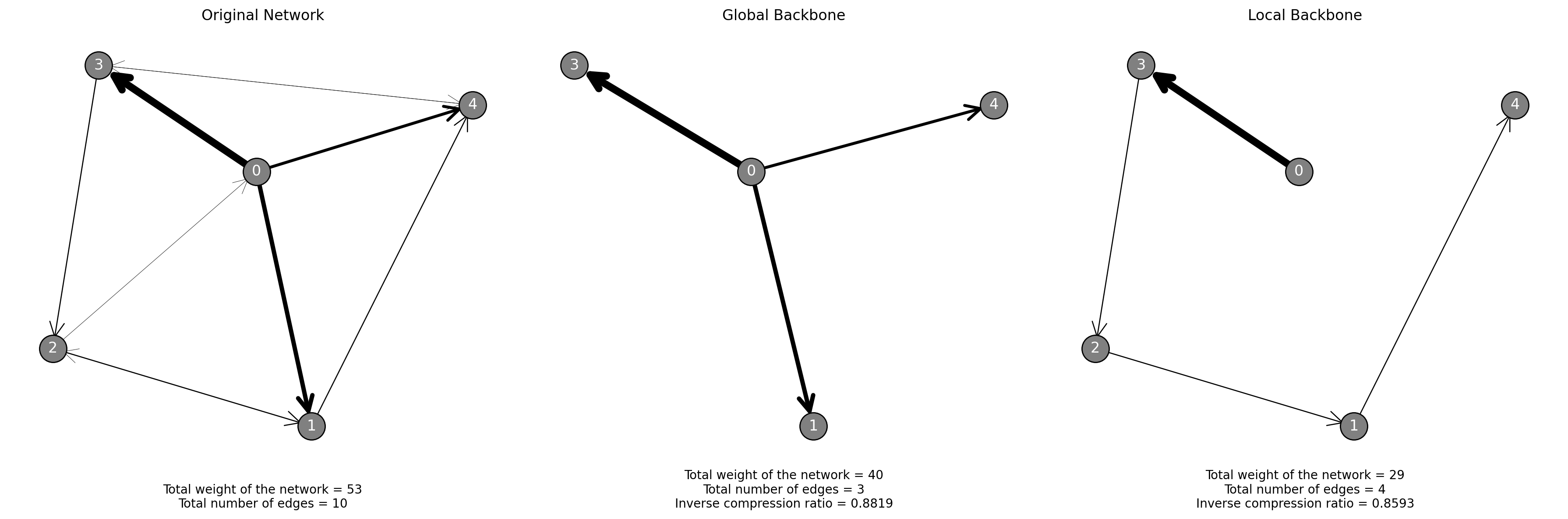
Left: Original weighted, directed network, with edge width proportional to weight. Center: Global MDL backbone, which learns a global threshold on the edge weights for network sparsification. Right: Local MDL backbone using out-neighborhoods. The local MDL method learns a threshold adapted to each neighborhood’s weight heterogeneity. Summary statistics are shown below each network.
Paper Source
If you use this algorithm in your work, please cite:
A. Kirkley, “Fast nonparametric inference of network backbones for weighted graph sparsification.” arXiv preprint arXiv:2409.06417 (2024). Paper: https://arxiv.org/abs/2409.06417