Partial Rankings
Tutorial
Code to infer partial rankings from pairwise interactions, paired comparisons are a standard method to infer a ranking between a series of players/actors. A shortcoming of many of these methods is that they lack mechanisms that allow for partial rankings –rankings where multiple nodes can have the same rank. Derived in “Learning when to rank: Estimation of partial rankings from sparse, noisy comparisons” (Morel-Balbi, Kirkley, 2025, https://arxiv.org/pdf/2501.02505).
The partial_rankings function minimizes the description length (DL) based on pairwise interactions to infer partial rankings. Preprocessing utilities are provided to prepare match data for analysis.
Inputs include:
match_list: Array of matches of the form
![[[i, j],...]](../_images/math/3461f4b762b48731eb91e504c17829b0ce1f6bb2.png) or
or ![[[i, j, w_{ij}],...]](../_images/math/1e486625a76d005e2c4fbaea82a360b0b07d68ba.png) , where
, where  is the number of times player
  beats player
  .
.N: Number of unique players in the match list.
M: Number of matches in the match list.
e_out, e_in: Dictionaries representing out-edges and in-edges for each node.
TARGET: Convergence criterion for iterative updates.
Outputs include:
R: Number of unique ranks inferred.
DL: Description length of the optimal ranking configuration.
LPOR: Log-posterior odds ratio of the inferred rankings relative to a baseline.
Strengths: Dictionary of player strengths.
Clusters: Grouping of nodes into ranks.
The method minimizes the following MDL objective at each step of the ranking inference:
Description Length Objective for Ranking Inference:

Where:
 is the global contribution to description length.
 is the node-level contribution.
 is the interaction contribution.
Partial Rankings
This module provides preprocessing functions for match lists and a core function for inferring partial rankings.
Function |
Description |
|---|---|
Compute the number of unique players in the match list. |
|
Compute the number of matches in the match list. |
|
Extract the in and out edges from the match list. |
|
Infer rankings from pairwise interactions. |
Reference
Description: Compute the number of unique players in the match list.
Parameters:
- match_list: Array of matches of the form :math:`[[i, j],...]` or :math:`[[i, j, w_{ij}],...]`.
- Returns:
int: Number of unique players.
Description: Compute the number of matches in the match list.
Parameters:
- match_list: Array of matches.
- return_unique: Boolean indicating whether to also return the number of unique matches.
- Returns:
int: Number of matches.
int (optional): Number of unique matches.
Description: Extract the in and out edges from the match list.
Parameters:
- match_list: Array of matches.
- Returns:
e_out: Dictionary of out-edges.
e_in: Dictionary of in-edges.
Description: Infer partial rankings from pairwise interactions by minimizing the description length.
Parameters:
- N: Integer number of nodes (players).
- M: Integer Number of edges (matches).
- e_out: Dictionary of out-edges.
- e_in: Dictionary of in-edges.
- TARGET: Float of convergence criterion, defaults to 1e-6.
- force_merge: Boolean to enforce merging of clusters with positive delta description length, defaults to True.
- exact: Boolean to use exact computation of player strengths, defaults to True.
- sync: Boolean to enable synchronous computation, defaults to False.
- full_trace: Boolean to return results at each merge step, defaults to False.
- verbose: Boolean to print verbose output, defaults to False.
- Returns:
list: If
full_trace=True, returns a list of dictionaries, each containing the results at every merge step, including the number of ranks, description length, strengths, and clusters.dict: If
full_trace=False, returns a dictionary containing results at the minimum description length, including: - R: Number of ranks inferred. - DL: Description length at the minimum. - LPOR: Log-posterior odds ratio relative to the baseline. - Strengths: Dictionary of player strengths. - Clusters: Grouping of nodes into ranks.
Demo
Example Code
This example demonstrates how to use the partial_rankings module to infer rankings from a match list, preprocess the data, and visualize the results.
Step 1: Import necessary libraries
from collections import Counter
import networkx as nx
import matplotlib
import matplotlib.image as mpimg
import matplotlib.pyplot as plt
import matplotlib.colors as mcolors
import numpy as np
from paninipy.partial_rankings import partial_rankings, get_N, get_M, get_edges
Step 2: Create a class for preprocessing and plotting
class RankingPlotGenerator:
    def __init__(self, matchlist_file):
        self.matchlist_file = matchlist_file
        self.matchlist = None
        self.graph = None
        self.results = None
        self.bt_results = None
        self.clusters = None
        self.sigmas = None
        self.bt_sigmas = None
        self.output_files = {"pr": "pr_network_ranking.png", "bt": "bt_network_ranking.png"}

    def load_and_preprocess(self):
        self.matchlist = np.loadtxt(self.matchlist_file, str, delimiter=" ")
        N = get_N(self.matchlist)
        M = get_M(self.matchlist)
        e_out, e_in = get_edges(self.matchlist)
        self.results = partial_rankings(N, M, e_out, e_in, full_trace=True)
        self.bt_results = self.results[0]
        self.sigmas = self.results[np.argmin([el['DL'] for el in self.results])]['Strengths']
        self.bt_sigmas = self.bt_results['Strengths']
        self.clusters = self.results[np.argmin([el['DL'] for el in self.results])]['Clusters']

    def create_graph(self):
        match_count = Counter([tuple(match) for match in self.matchlist])
        weighted_matchlist = np.array([[match[0], match[1], count] for match, count in match_count.items()])
        self.graph = self._nx_from_match_list(weighted_matchlist)

    @staticmethod
    def _nx_from_match_list(matchlist):
        g = nx.DiGraph()
        node_ids = set(matchlist[:, 0]).union(set(matchlist[:, 1]))
        for node in node_ids:
            g.add_node(node, id=node)
        for match in matchlist:
            i, j = match[0], match[1]
            weight = int(match[2]) if len(match) == 3 else 1
            g.add_edge(i, j, weight=weight)
        return g
Step 3: Preprocess and visualize rankings
# Initialize and process the match list
generator = RankingPlotGenerator("wolf.txt")
generator.load_and_preprocess()
generator.create_graph()

# Retrieve and process the graph for both BT and Partial Rankings
g_pr = generator.graph.copy()
g_bt = generator.graph.copy()

# Get sigmas
pr_sigmas = generator.sigmas
bt_sigmas = generator.bt_sigmas

# Dctionary mapping node labels to pr sigmas
label_to_pr_sigma = {}
for node in g_pr.nodes():
    for key, cluster in generator.clusters.items():
        if node in cluster:
            label_to_pr_sigma[node] = pr_sigmas[key]

# Initialise node coordinates
for i, node in enumerate(g_pr.nodes()):
    x = -i
    y_pr = np.log(label_to_pr_sigma[node])
    y_bt = np.log(bt_sigmas[node])
    g_pr.nodes[node]['pos'] = (x, y_pr)
    g_bt.nodes[node]['pos'] = (x, y_bt)

# Adjust positions of nodes in the same cluster
for key, cluster in generator.clusters.items():
    if len(cluster) == 1:
        # Set x-coordinate to zero
        g_pr.nodes[list(cluster)[0]]['pos'] = (0, g_pr.nodes[list(cluster)[0]]['pos'][1])
        g_bt.nodes[list(cluster)[0]]['pos'] = (0, g_bt.nodes[list(cluster)[0]]['pos'][1])
    elif len(cluster) == 2:
        # Evenly space in [-a, a] interval
        a = 2
        x_coords = np.linspace(-a, a, len(cluster))
        for i, node in enumerate(cluster):
            g_pr.nodes[node]['pos'] = (x_coords[i], g_pr.nodes[node]['pos'][1])
            g_bt.nodes[node]['pos'] = (x_coords[i], g_bt.nodes[node]['pos'][1])
    else:
        # Evenly space in [-a, a] interval
        a = 6
        x_coords = np.linspace(-a, a, len(cluster))
        for i, node in enumerate(cluster):
            g_pr.nodes[node]['pos'] = (x_coords[i], g_pr.nodes[node]['pos'][1])
            g_bt.nodes[node]['pos'] = (x_coords[i], g_bt.nodes[node]['pos'][1])

# Define node colors
vertex_fill_color = {}
for cluster_label, cluster_nodes in generator.clusters.items():
    for node in cluster_nodes:
        if node in generator.graph.nodes:
            if cluster_label in generator.sigmas:
                vertex_fill_color[f"pr_{node}"] = np.log(generator.sigmas[cluster_label])
            if cluster_label in generator.bt_sigmas:
                vertex_fill_color[f"bt_{node}"] = np.log(generator.bt_sigmas[cluster_label])
for node, strength in generator.sigmas.items():
    if node in generator.graph.nodes:
        vertex_fill_color[f"pr_{node}"] = np.log(strength)
for node, strength in generator.bt_sigmas.items():
    if node in generator.graph.nodes():
        vertex_fill_color[f"bt_{node}"] = np.log(strength)
vmin = min(vertex_fill_color.values())
vmax = max(vertex_fill_color.values())
norm = mcolors.Normalize(vmin=vmin, vmax=vmax)
colormap = plt.cm.Reds
node_colors = {node: colormap(norm(color)) for node, color in vertex_fill_color.items()}

# Plot the graph
fig, ax = plt.subplots(1, 2, figsize=(10, 6))
plt.subplots_adjust(wspace=0.5)
pos_pr = nx.get_node_attributes(g_pr, 'pos')
pos_bt = nx.get_node_attributes(g_bt, 'pos')
node_colors_pr = [node_colors[f"pr_{node}"] for node in g_pr.nodes() if f"pr_{node}" in node_colors]
node_colors_bt = [node_colors[f"bt_{node}"] for node in g_bt.nodes() if f"bt_{node}" in node_colors]
nx.draw(
    g_bt, pos_bt, with_labels=True, node_size=500, font_size=12,
    edgecolors='black', node_color=node_colors_pr, ax=ax[0]
)
nx.draw(
    g_pr, pos_pr, with_labels=True, node_size=500, font_size=12,
    edgecolors='black', node_color=node_colors_bt, ax=ax[1]
)

# Add colorbar
cbar_ax = fig.add_axes([0.475, 0.15, 0.02, 0.7])  # Position: [left, bottom, width, height]
norm = matplotlib.colors.Normalize(vmin=vmin, vmax=vmax)
cbar = fig.colorbar(plt.cm.ScalarMappable(norm=norm, cmap=plt.cm.Reds), cax=cbar_ax)
cbar.set_label('Log-Strength', fontsize=12)
cbar.ax.tick_params(labelsize=12)

# Add titles and labels
ax[0].set_title("BT Rankings", fontsize=14)
ax[0].text(0.5, -0.05, r"$R = N = 15$", ha="center", va="center", fontsize=14, transform=ax[0].transAxes)
ax[0].text(0.5, -0.18, "(a)", ha="center", va="center", fontsize=14, transform=ax[0].transAxes)
ax[1].set_title("Partial Rankings", fontsize=14)
ax[1].text(0.5, -0.05, r"$N = 15,~R = 10$", ha="center", va="center", fontsize=14, transform=ax[1].transAxes)
ax[1].text(0.5, -0.18, "(b)", ha="center", va="center", fontsize=14, transform=ax[1].transAxes)
plt.savefig("bt_pr_network_example.png", dpi=400)
Step 4: View the results
The resulting plot visualizes the node rankings based on the BT and Partial Rankings methods. You can see the output graph saved as bt_pr_network_example.png.
Example Output
Initial DL: 1056.1296139224828
Initial Ranks: 15
Tolerance: 1e-06
Converged in 15 iterations
Partial Rankings: 10
Initial DL: 1056.1296139224828
Min DL: 1049.512972670665
BT DL: 1025.5222923375397
LPOR: -23.990680333125283
CR: 0.9937350102065187
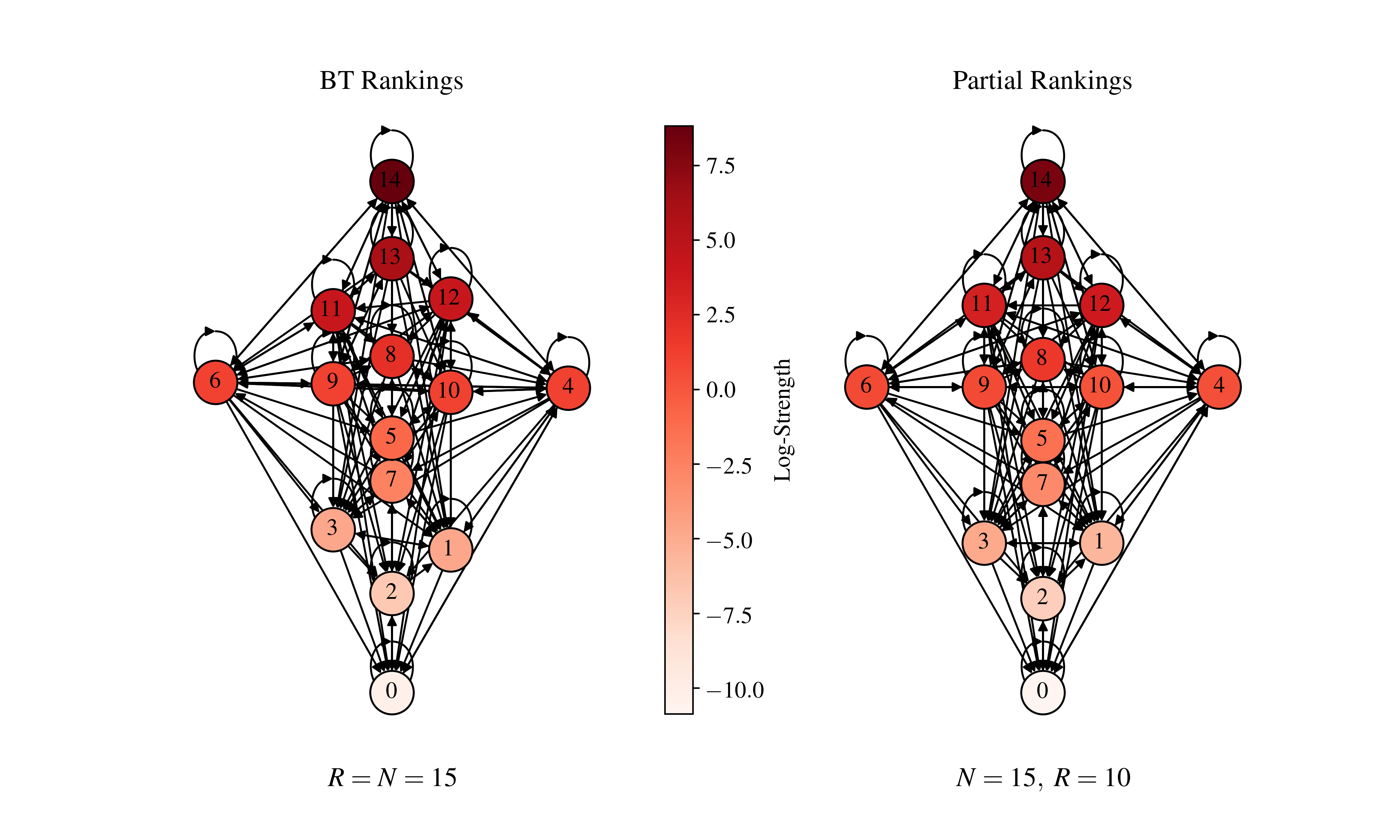
The left graph represents the BT Rankings, and the right graph shows the Partial Rankings. Each node’s position and color correspond to its ranking and strength.
Paper Source
If you use this module in your work, please cite:
Morel-Balbi and A. Kirkley. “Learning when to rank: Estimation of partial rankings from sparse, noisy comparisons.” arXiv preprint arXiv:2501.02505 (2025).